

So, I did a cool thing recently. Or a very nerdy thing. Where you stand says something about you, I suppose. I honestly can’t tell anymore.
Back in the day, my friends and I were mix-tape people. We made them, we traded them, and we listened to them. I listened to them a lot, in fact. Probably more than the actual albums I took the songs from.
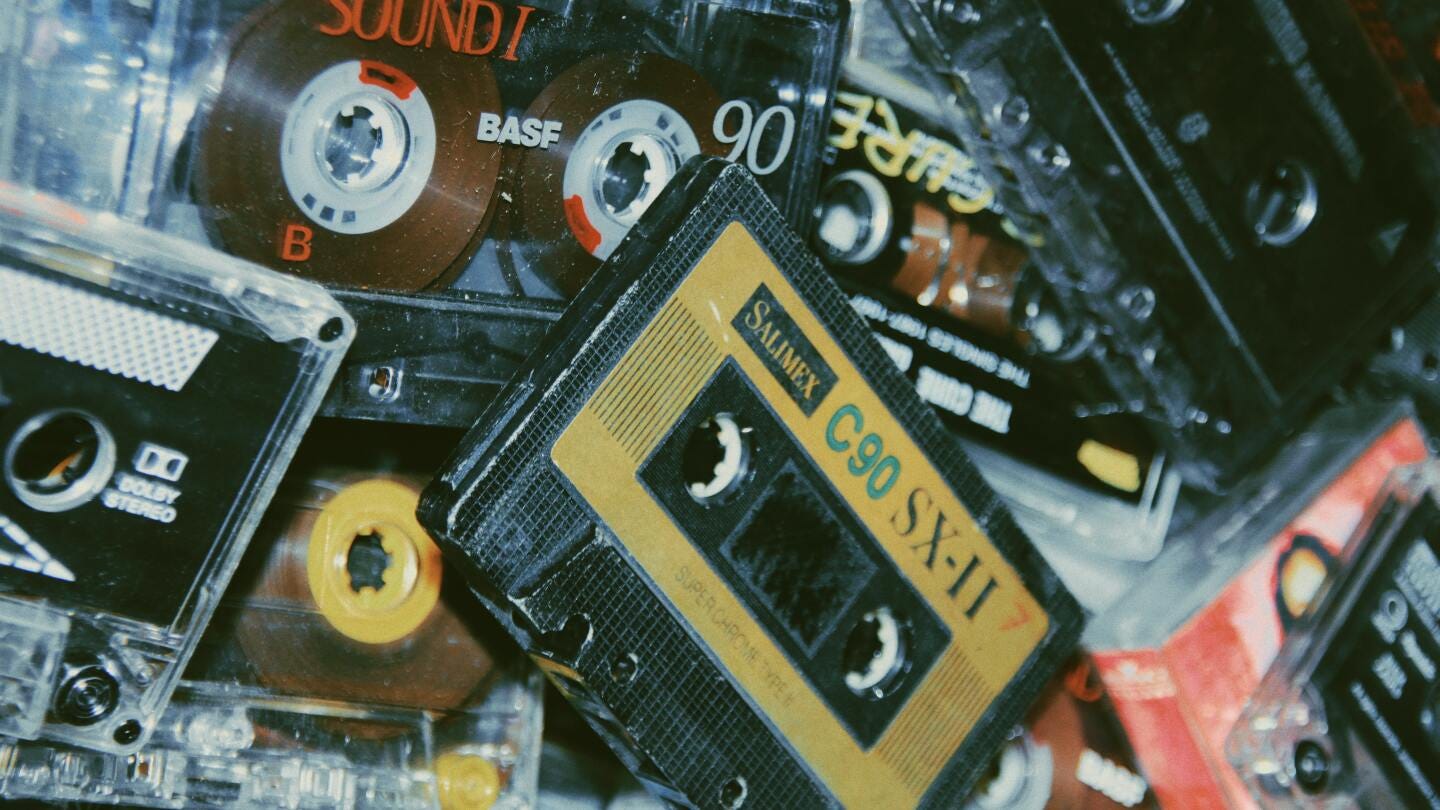
This was the 90s, so while we were all primarily buying CDs at this point, our cars still had tape players. So the best way to listen to CDs while driving was to copy them onto tapes. But it seemed kind of boring to just copy a whole CD, especially when each one probably had at least a few songs that were busts, or maybe only a few songs that were any good. So it made sense to put the good songs on a tape so you wouldn’t have to fast-forward over songs you didn’t want to hear.
But a tape was also usually 90 minutes long — or 60 if you went that route, but why would you? So you could fit 18 or 20 songs on a tape if you wanted to fill it. It made sense to us that if you really liked a band, you’d fill a tape up with their best songs. And you could arrange the songs for the best sound quality. For example, Rush released the guitar-heavy Counterparts in 1994, but their previous album, Roll the Bones, while featuring some great songs, was a bit tinny, so if you were making a Rush compilation, you couldn’t put a Counterparts song next to a Roll the Bones song or it would be blown away.
Ok, that sounded a bit nerdy.
Still, we were mostly creative people, so making a mix-tape went beyond just collecting a band’s greatest hits. We would make tapes with a bunch of our favorite songs and include clips from shows and movies we liked (usually nerdy ones, like Star Trek), edited in between the songs. Sometimes the clips would relate to the song they preceded, sometimes they were random, but hopefully they were funny. I mean, who wouldn’t want to hear a Homer Simpson quote before “Alive” by Pearl Jam?
Sometimes the tapes themselves had a theme, and sometimes they were just a bunch of songs we liked. And if you were making the tape for a friend, you would try to add songs they weren’t familiar with or didn’t already own to expand their horizons a little. We all basically listened to the same bands, so that was hard, but once in a while you could find a diamond in the rough.
The point is, they weren’t something you dashed off in an afternoon. If you promised someone a mix-tape, it took time. Even if it was just a bunch of songs you thought they’d like, they still had to play well with each other. If a song ended on a hard note, the next song had to start fast. A song that fades out at the end? That might be a good place for a clip before the next song.
And there were unwritten rules to be followed. For instance, no more than two songs per band, and they had to be on separate sides of the tape. And a cool name for the tape — usually another movie quote — had to be assigned to it. Just like a real album.
And obviously, if you liked a girl, giving her a mix-tape was a definite sign of your intentions. You might as well have named the tape “I Want to Have Sex With You.”
Now it is sounding really nerdy, but that’s what we did.
Sadly, most of my mix-tapes have long since been lost to time, much like the cars I played them in. I’m not too sad about it now, because that’s just what happens as we get older.
But here’s where this post gets really nerdy: I recently found a couple of the inserts from mix-tapes that were made for me back then. If you’re too young to know, the inserts — or inlays, or J-cards? I didn’t know that was what people called them until I googled it just now — were basically the covers where you could list the songs and, if you were really feeling it, add some cover art. I assume, for nostalgia purposes, I had saved the inserts but thrown out the tapes. I guess the inserts take up less space?
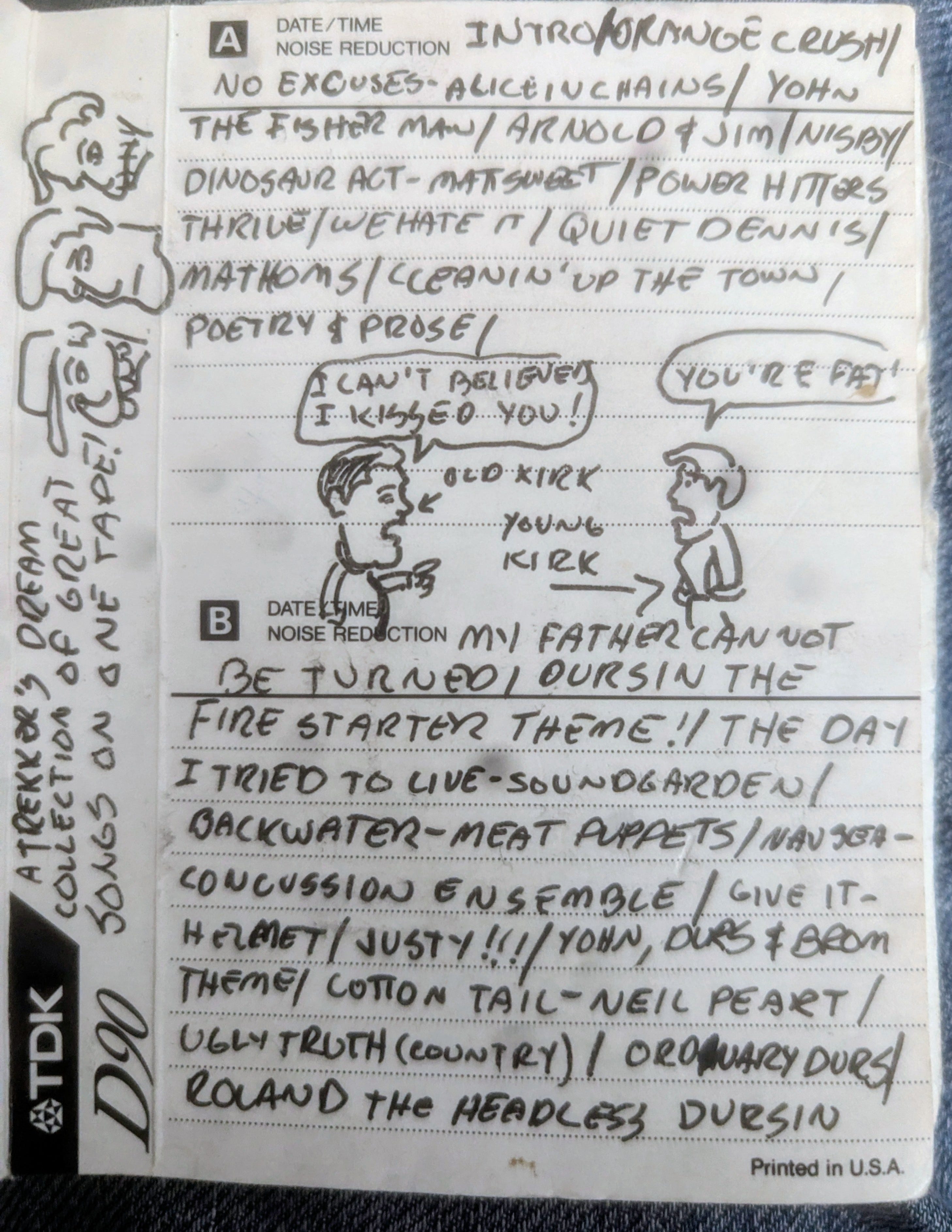
One of the inserts was for a tape my brother made me for my high school graduation. There was a loose “freedom” theme to it. At least that’s what I got out of it, since he actually included “Freedom! ’90” by George Michael, which may be a little on the nose. It was an excellent tape that followed all the rules — clips, cover art, no repeat artists on either side, even a cool title: “Slimeball in a Sea of Puss,” an insult from one of our favorite movies, Midnight Run.
It was a masterwork, so I decided to make a Spotify playlist of the songs and share it with him. He texted back immediately, asking if it was the digital version of the mix-tape he made for me, even remembering the year (1994). I responded that it was, but “unfortunately, the Kelly song from Cheers was not on Spotify.”
I’m glad I could share this walk down memory lane with him. We talked later about the art of the mix-tape: the editing, the thought that went into it, tailoring it to the recipient. But also the loss of the clips. To me, they were the real genius of the mix-tape. The clips didn’t make the playlist. Sure, I could probably find them on YouTube, convert them to MP3s, and add them to Spotify as podcast tracks before inserting them into the playlist.
But I’m not that nerdy.
The Spotify playlist is incredibly convenient, easily accessible, and will never get twisted up in your tape player, but it is not the modern-day mix-tape. Because nothing is. Mix-tapes were a product of their time, and they introduced me to a lot of new songs I may not have known about otherwise, while also providing me with a lot of joy. But that time has passed, and that’s fine. I still have the songs.
I’ll just have to imagine the Homer quote.
Thanks for reading, as always. Please like and subscribe, or send me some love on Buy Me A Coffee. I also have a podcast that could use some lovin’, and a comic.
Keep on keepin’ on.