

A couple years ago, I posted about showing movies in my previous life as an A/V guy at a local university. There was a film I would show every year to the students called Obedience, also known as The Milgrom Experiment, also known as “The one where the guy yelled ‘Let me out of here!’ is a pretty funny way.” In case you missed it, here it is:
Movies That Settle: Obedience - The Milgram Experiment

For nearly 20 years of my adult life, I worked at a small liberal arts college which was part of a larger, prestigious university. One of my tasks was to facilitate film showings, and every year for probably eighteen of those 20 years, I presided over multiple showings of a documentary called
If you liked that one, or even if you didn’t, here’s another story form my days as a projectionist at that college. If you didn’t click the link, the opening line that one of my jobs was “facilitating” film showings. I thought it was a cool way to describe it on my resume, but most of the time it wasn’t all that cool.
There was a 640-seat auditorium in the building where most of the screenings took place, which gave them a certain sense of importance. At the time, students didn’t have easy access to many of the assigned films, so attendance was usually strong.
The real complication was that the Dean of the college was an older gentleman who liked the idea of showing movies on actual film. So the school still owned several 16mm projectors.
Showing a movie on 16mm was a process.
You had to thread the film from the supply reel through the projector gate and onto a second reel in the back known as the take-up reel. As the movie played, the take-up reel collected the film. Afterward, everything had to be rewound onto the original reel so it could be returned to the university film library properly.
This was a lot more serious than forgetting to rewind a video store rental.
Most feature films arrived on three or four reels, each running roughly thirty to forty minutes. That meant using two projectors side by side and switching between them during the movie.
The signal for the switch was what projectionists called a “cigarette burn”—a small white circle that briefly appeared in the upper-right corner of the screen near the end of a reel. Once I learned of this, I could not watch movies the same anymore. I always saw the cigarette burn until theaters started using digital projectors.

Still, if you timed the switch correctly, the general audience never noticed. If you timed it poorly, everyone noticed.
For films longer than two reels, things became trickier.
While projector #2 played reel #2, I had to rewind reel #1, load reel #3 onto projector #1, thread it in the dark, and make sure the lamp and sound were off so I didn’t accidentally blast random frames and noise into a packed auditorium.
It was a juggling act. But when it went well, I felt strangely proud of myself.
The students probably never noticed. But I always did.
These screenings were the hardest part of the job, which is why one of my first requests for the department was a DVD player. Once we got one, I quietly switched most screenings to DVD. I never mentioned that to the Dean. What he didn’t know wouldn’t hurt him. Besides, this wasn’t film school.
Still, a few titles weren’t available on DVD yet, and one of them returned every year like a tax bill.
It was a special educational cut of Nicholas and Alexandra, the historical epic about the fall of the Russian royal family. The original film ran over three hours, but the university had acquired a shortened version on 16mm for classroom use.
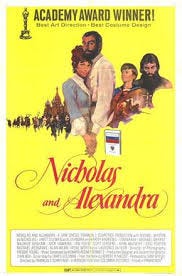
The Social Science department screened it every November. Which meant every November, so did I.
I dreaded those days every year, but one year was worse than the others.
Everything began normally. I set up the two projectors, threaded reel #1, dimmed the lights, and started projector #1.
Then I zoned out for a few minutes, having already seen enough of Nicholas and Alexandra for one lifetime.
When I looked back, I saw the take-up reel wasn’t turning.
Film was pouring onto the floor.
In a frenzy, I tried spinning the reel by hand, but several feet had already piled up around my shoes. Worse, the reel change was only minutes away, which would require both hands.
When the cigarette burn appeared, I let go, shut off projector #1, and started projector #2.
The movie continued.
I then dragged out a third projector and hurriedly loaded reel #3, since projector #1 was clearly finished for the day. Somehow I got it ready in time and made the second reel change without disaster.
Meanwhile, reel #1 lay beside me in a heap like cinematic spaghetti.
When the Russian Revolution finally ended, I dropped to my knees and began winding the tangled film by hand. It had to be rewound properly so it could be shown again the next day. Mostly, though, I wanted to throw it in the trash.
As I sat there wrapped in loose film like a mummy, someone knocked on the projection booth door. It was one of the professors. I expected criticism. Maybe a complaint about a rough transition or a slight delay.
Instead, he looked down at me kneeling in the pile of film and said:
“Matt, that was the best screening we’ve ever had. Thanks.”
Then he closed the door and walked away.
Even though I could have used some help at that moment, it instantly became the best screening I ever had.
I never projected movies at my movie theater job. I never physically pressed play on anyone’s VCR when I worked at Video Showplace. But that day, hundreds of students watched a near-flawless screening because I kept the thing alive through panic, luck, and stubbornness.
A few years later, the film library finally made me a VHS copy of the edited Nicholas and Alexandra, and I never had to run it on 16mm again.
But that time, I facilitated it. And for once, I actually knew exactly what that meant.
Thanks for reading, as always. Please check out my podcast, and if you feel like contributing in ways other than subscribing, you can Buy me a Coffee. Also, feel free to drop me a line or comment if you happen to have old film screening stories.
Keep on keepin’ on.
Very nice recollection.
Quite impressive I assumed you had done your fair share of making the show happen, I’m not sure I would have been able to pull it off! In my mind’s eye the professor was British and gave you a” Pip Pip old chap that was the finest screening of my day!” — cinematic either way even if the old boy didn’t help you physically he helped in … a different way!