

I received a text recently from an old friend that Pulp Fuction was released 30 years ago this week. Note that I said he was an “old” friend. He and I were 18 when this movie came out, and I was just a young, dumb, freshman in college, and I was already a big fan of Tarantino. In fact, one of my first college papers was written about him. As I have stated in previous posts, I was a film major, so it wasn’t as weird as it sounds. I actually wanted to basically be Quentin Tarantino, but as the song used for the famous twist contest says, “‘Ce la vie say the old folks. It goes to show you never can tell.” Hmmm. There’s that word again: old.
First off, let me state right off the bat that this post isn’t about why Marsellus Wallace had a band-aid on the back of his neck, or what was in the briefcase. Honestly, those are pretty minor details that I didn’t really care about 30 years ago, and care even less about now. This movie is really about what all of Tarantino’s best movies are about: the people. And this post is about what all my posts are about: how I experienced Pulp Fiction 30 years ago.
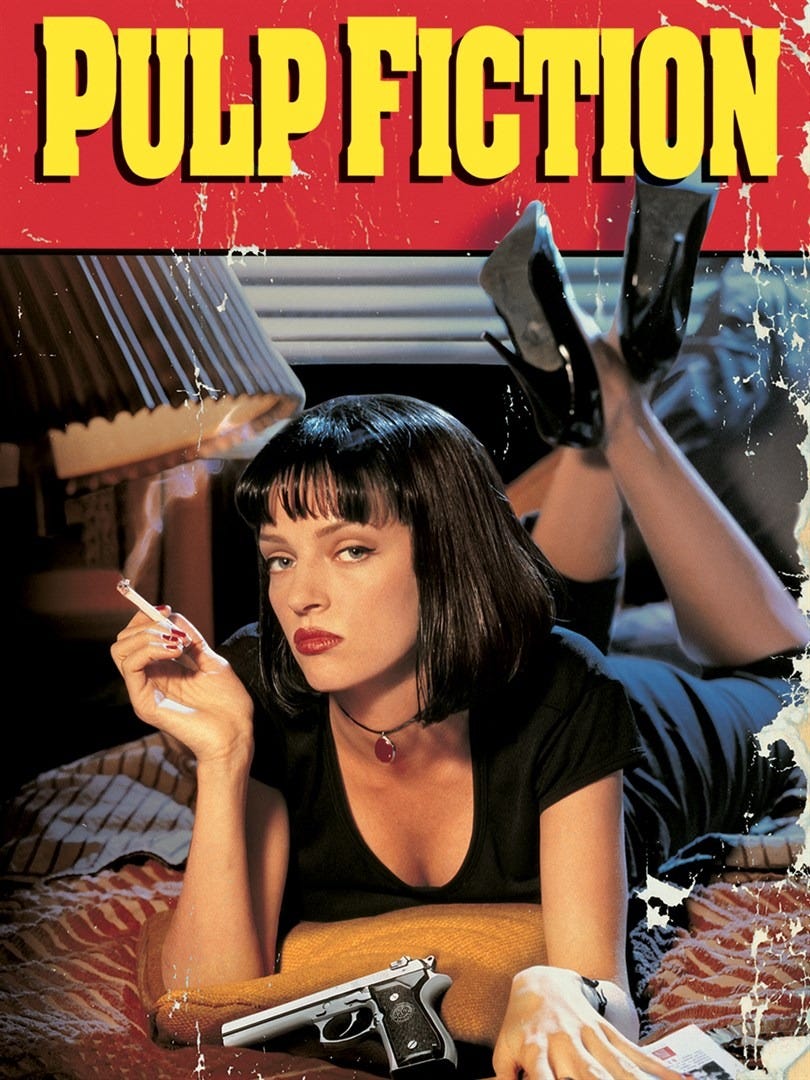
I worked in a movie theater at the time, and received free passes as part of my wages, so I naturally dragged all of my friends to go see this kooky movie with me with the promise that it would be free. I don’t think they had a lot of interest in it, otherwise, but this was how I bought friendships back then.
I kid. Truly, this movie came along when me and my friends were at the perfect age to be exposed to it. We were young and irreverent, so it made sense that we would enjoy a movie about gangsters and lowlifes who talk like regular folks. When you’re 18, how can you not love two guys debating the intentions of a foot massage just before they enter an apartment to kill a bunch of guys? And yet, even these bad guys can find redemption, as Jules does in the film’s final scene. It had everything a guy like me could want in a movie back then. It was basically Seinfeld with guns.
However, I will admit that there were aspects of it that went over my head back then. I was certainly too inexperienced and stupid to fully grasp Vincent’s (John Travolta) dilemma when it came to taking his boss’ wife out to dinner. I had many female friends at the time, and I had meals with them that had almost no sexual tension bubbling under the surface. It may have been because I had no self-confidence, or because I had no game, or it may have been because I didn’t want them to ask me to enter a twist contest. Whatver the reason, I only really understood that storyline on a fringe level. And that’s ok, because the real drama of that section of the film is not the sexual tension, but the fact that Mia almost died.
Speaking of which, one of my favorite memories of working in that theater was that we eventually got Pulp Fiction (not first run, but still…) We only had 2 screens, so once the two movies started, the employees had some downtime, so I would always try to sneak into the theater to see Uma Thurman’s Mia’s overdose scene. I kind of feel like it is missing from the movie-going experience today, because when Vincent lifts that syringe to jam into her chest, and holds it there for just a couple seconds, and the camera focuses on the drop of adrenaline at the tip of the needle, the red dot that he drew on her chest to mark its destination, and Rosana Arquette’s amused reaction, the entire theater would hold its breath in anticipation. It’s been 30 years, and I have seen a lot of movies, and I don’t think I have experienced that kind of tension too many times.
Funny side note: they apparently filmed that backwards. Tarantino was not satisfied with a fake chest plate for Uma Thurman to wear, so he had Travolta start the needle right above her chest and pull it backwards, and they simply reversed it in the editing room. To quote Arquette from that very scene, “That was trippy.”
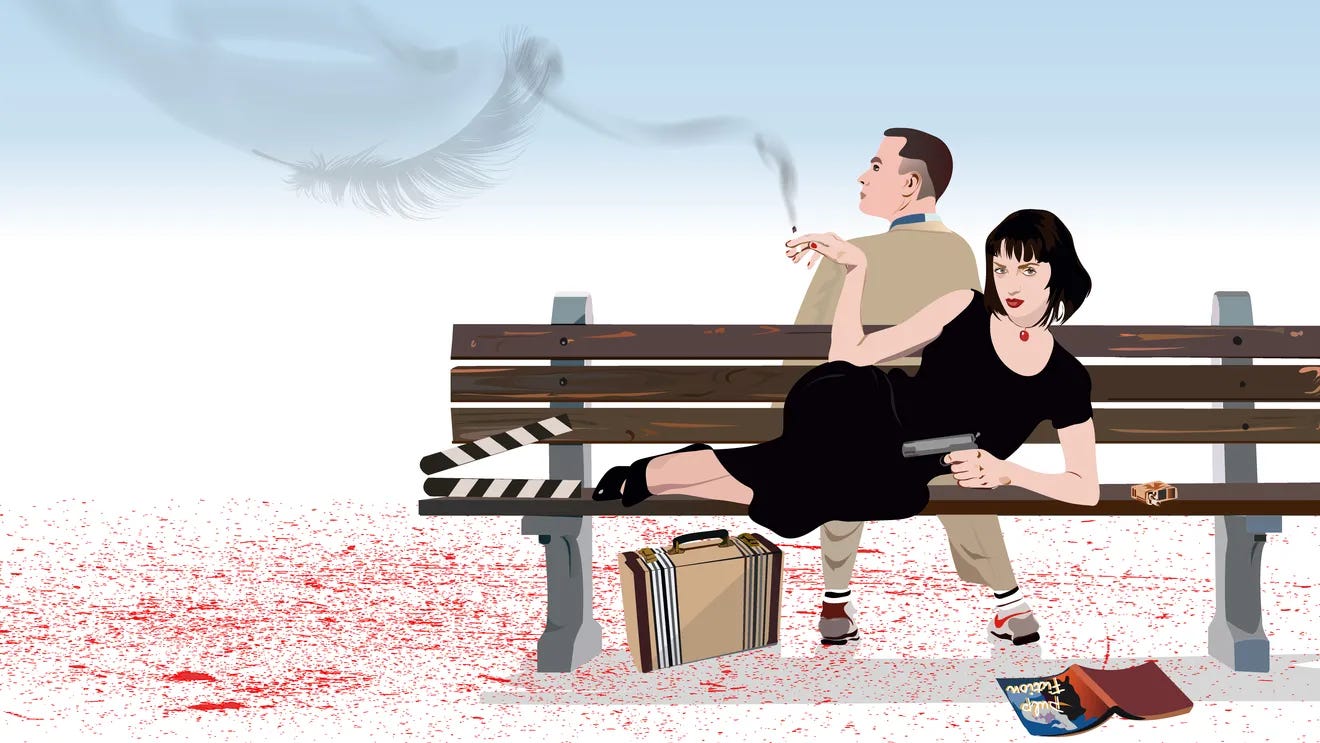
You know what else was trippy to my young, naive brain? The Gimp scene. I had been weened on Star Wars and G.I. Joe, and even the R-rated movies I had seen, like Goodfellas or Robocop, were mostly rated R for language and violence. There wasn’t really a lot of guy-on-guy raping going on. Which is probably why Tarantino put it in there, because it hadn’t been done in American cinema. He just wanted to what the audience squirm. Well, mission accomplished. We probably all woke up a little after that one. And it still got nominated for Best Picture. Should have won, too. Is anybody writing about how great Forrest Gump is at 30?
But as I touched on earlier, for a movie that is shown to us out of order, the big climax is still at the very end (Another side note: in my journey to try and become the second coming of Quentin, I took screenwriting classes, and one thing we covered was that Pulp Fiction still follows basic three-act screenplay structure despite all the time jumps. Pretty neat, huh?) Throughout the entire movie, Samuel L. Jackson’s Jules is clearly the character that the audience identifies with the most. He is the character that has an arc. Early on, he has a moral take on the alleged foot massage. He then quotes The Bible before he wastes Brett, the poor idiot who stole the briefcase. And when he and Vincent are nearly killed by a scared gunman, he chalks it up to divine intervention, and decides to become someone worthy of being saved. It is only then that he realizes what the oft-quoted Bible passage really means. As a gangster, a guy so bad that even his wallett says “Bad Mother Fucker” on it, he is the tyranny of evil men, but now, he’s going to try to be the shepherd. Basically, we’re all a work in progress, and I like to think Jules ended up doing exactly what he said he would do: roam the countryside in search of adventures. Or he became the head of S.H.I.E.L.D.
And in what is still one of my favorite final shots of any movie, Jules and Vincent casually walk towards the door, pause to take a look around, stick their pistols into their shorts, and walk out to the tune of The Lively Ones’ “Surf Rider.” I’m not sure how to even describe it except to say it’s like Fonzie. And what’s Fonzie like? Come on, Yolanda, what’s Fonzie like?
Correctomundo!
Basically, this whole movie is pretty cool. Of course, I see it on a different level now that I am 48, but the one thing that my 18 year-old self and my 48 year-old self can agree on is that it is still like Fonzie after all these years.
Thanks for reading. Don;t forget to like and subscribe and check out all my other posts.
A great review! Now I feel older than I did before my birthday! I hope Tarantino doesn't stop making movies well into being an old man. Every dorm room had this poster or Reservoir Dogs! Uma is a delight, and I love Eric Stoltz in this one, too.