

Here we go; what may be the ultimate Suplexes to SAG cards story. How did Dwayne Johnson become one of the biggest stars in wrestling and then go on to become one of the biggest stars in Hollywood? And perhaps more importantly, go back to wrestling?

The story of The Rock goes back generations in the wrestling business. You may have learned some of this on Young Rock—if you were one of the few people who watched it—but it begins with his grandfather, Samoan High Chief Peter Maivia, who wrestled in Hawaii before touring the world. At one stop, his daughter Ata met and married fellow wrestler Rocky Johnson. From that union came a son: Dwayne.
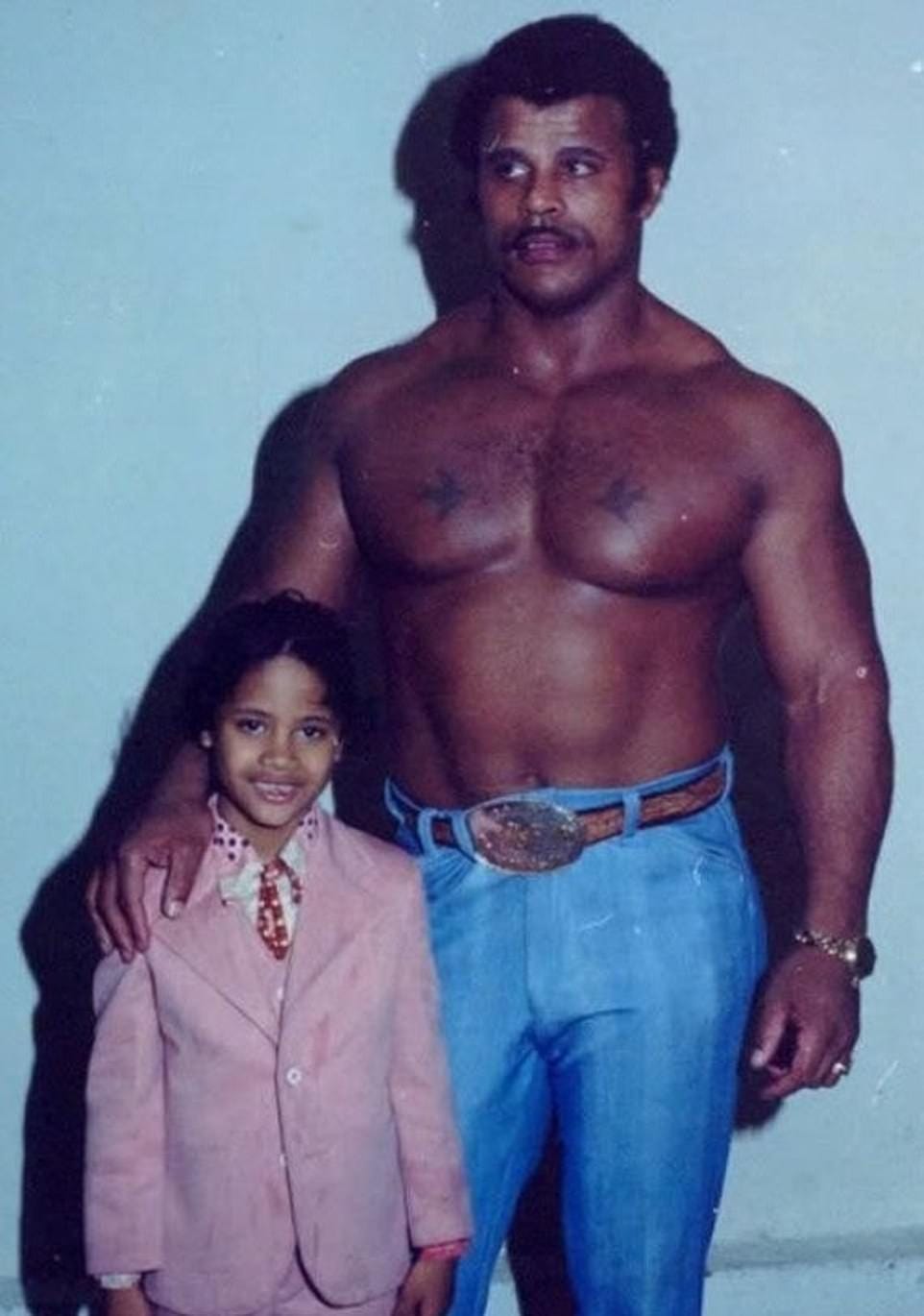
Dwayne didn’t head straight into wrestling. Instead, he pursued football, even playing defensive tackle for the national champion Miami Hurricanes in 1991. After graduating in 1995, he went undrafted by the NFL but was picked up by the Calgary Stampeders of the Canadian Football League. Two months later, he was cut. He returned home famously with just seven dollars to his name—a moment he would later commemorate by naming his production company Seven Bucks Entertainment.
Dwayne asked his father for help. Despite misgivings about his son entering the wrestling business, Rocky agreed to train him. After a short period, Rocky reached out to his contacts in the World Wrestling Federation and got Dwayne in the door. By mid-1996, Dwayne was wrestling for the WWF, and by November he made his pay-per-view debut with a major push as a future star under the name Rocky Maivia.

Young male fans, however, didn’t embrace Rocky the way the WWF had hoped. He was soon turned heel, and that’s when things clicked. Freed from the forced smile, Dwayne flourished. He dropped the last name, began referring to himself in the third person, and became simply “The Rock.” He popularized phrases that entered mainstream culture—“SmackDown” even made it into the dictionary. He was so entertaining, his popularity exploded to the point that the company had no choice but to turn him back into a good guy.

By late 1999, Johnson was a multiple-time champion when the WWF’s top-grossing star of all time, “Stone Cold” Steve Austin, stepped away for neck surgery. The Rock filled that void and enjoyed one of the most financially successful runs in company history. That popularity opened doors beyond wrestling. After small television roles, he made his film debut in The Mummy Returns (2001), followed by starring roles in The Scorpion King, The Rundown, and Walking Tall. Hollywood saw a ready-made action star—but wrestling wasn’t finished with him yet.
When Johnson took time away to film movies, he often returned as a conquering hero, and fans were ecstatic. But as the absences became more frequent, resentment set in. As I mentioned in my John Cena post, wrestling fans can be possessive. They didn’t like that The Rock wasn’t on TV every week. In August 2002, while defending the WWE Championship against rising star Brock Lesnar, Rock was heavily booed. He left again, but returned in early 2003 for WrestleMania season—this time as a heel. Not just any heel, but a smug, wealthy Hollywood jerk.
He manipulated the audience so effectively, however, that they actually cheered him again. At WrestleMania that year, he retired his longtime rival, Steve Austin, then a month later, he disappeared once more.
Because of the law of diminishing returns, Rock’s appearances grew less impactful. After a 2004 run as a babyface, he shifted to sporadic appearances. He even sued WWE for the rights to use the name “The Rock” in films, eventually dropping it altogether and becoming simply Dwayne Johnson. He starred in action films, comedies, and action movies that are basically comedies, like the Fast & Furious franchise. Over time, he shed the stigma of being a wrestler doing movies and became just a movie star.
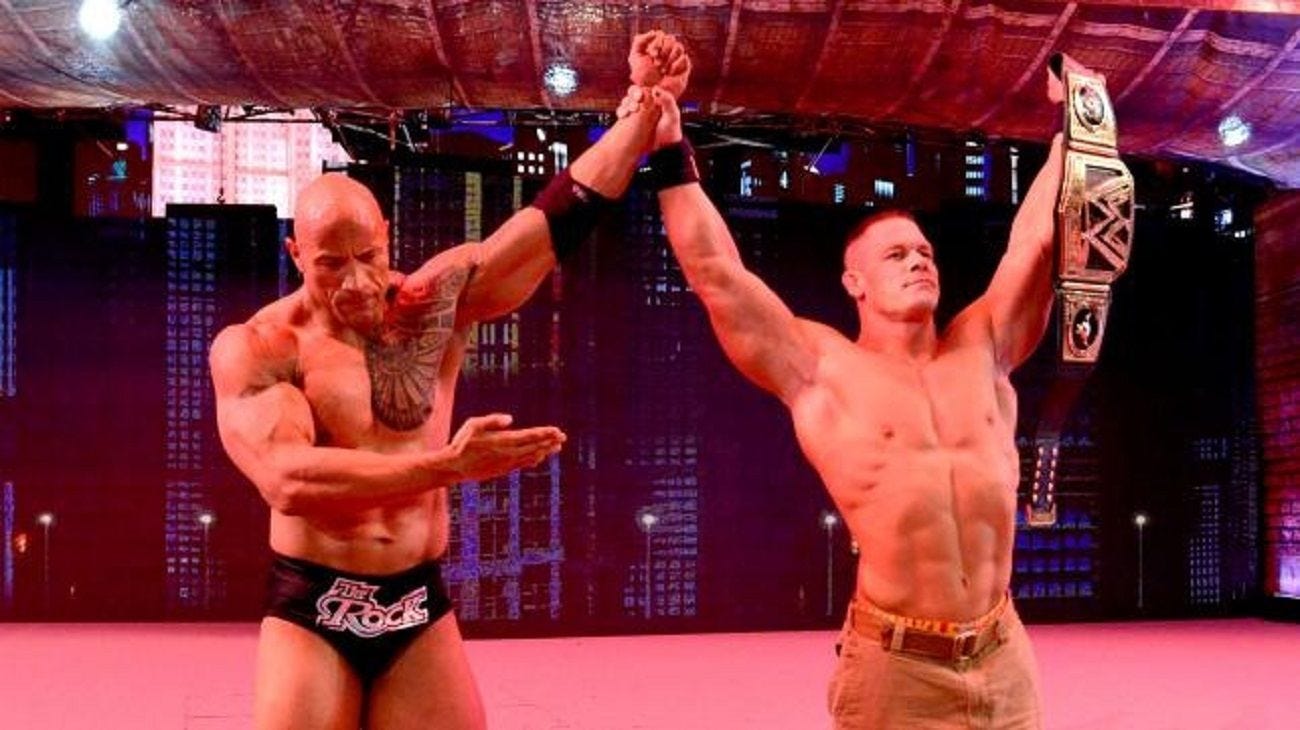
In 2011, he returned to begin a two-year storyline with John Cena, WWE’s crossover star at the time. Cena, still a full-time wrestler, had criticized Rock in interviews for coming back for big moments while calling wrestling his home, only to disappear to Hollywood. The two traded barbs, and in 2012 Rock defeated Cena in the main event of WrestleMania in what WWE billed as a “Once in a Lifetime” match. Because this is pro wrestling, they ran it back a year later. This time Cena won, and Rock endorsed him as the face of the company—a symbolic passing of the torch, even though Cena had already held that role for years. It seemed like a clean ending, especially after Rock tore his abdominal and adductor tendons off his pelvis, requiring triple hernia surgery that delayed production of Hercules. Many assumed no studio would risk hiring him if he kept wrestling. In his early 40s, it looked like time to hang up the boots.
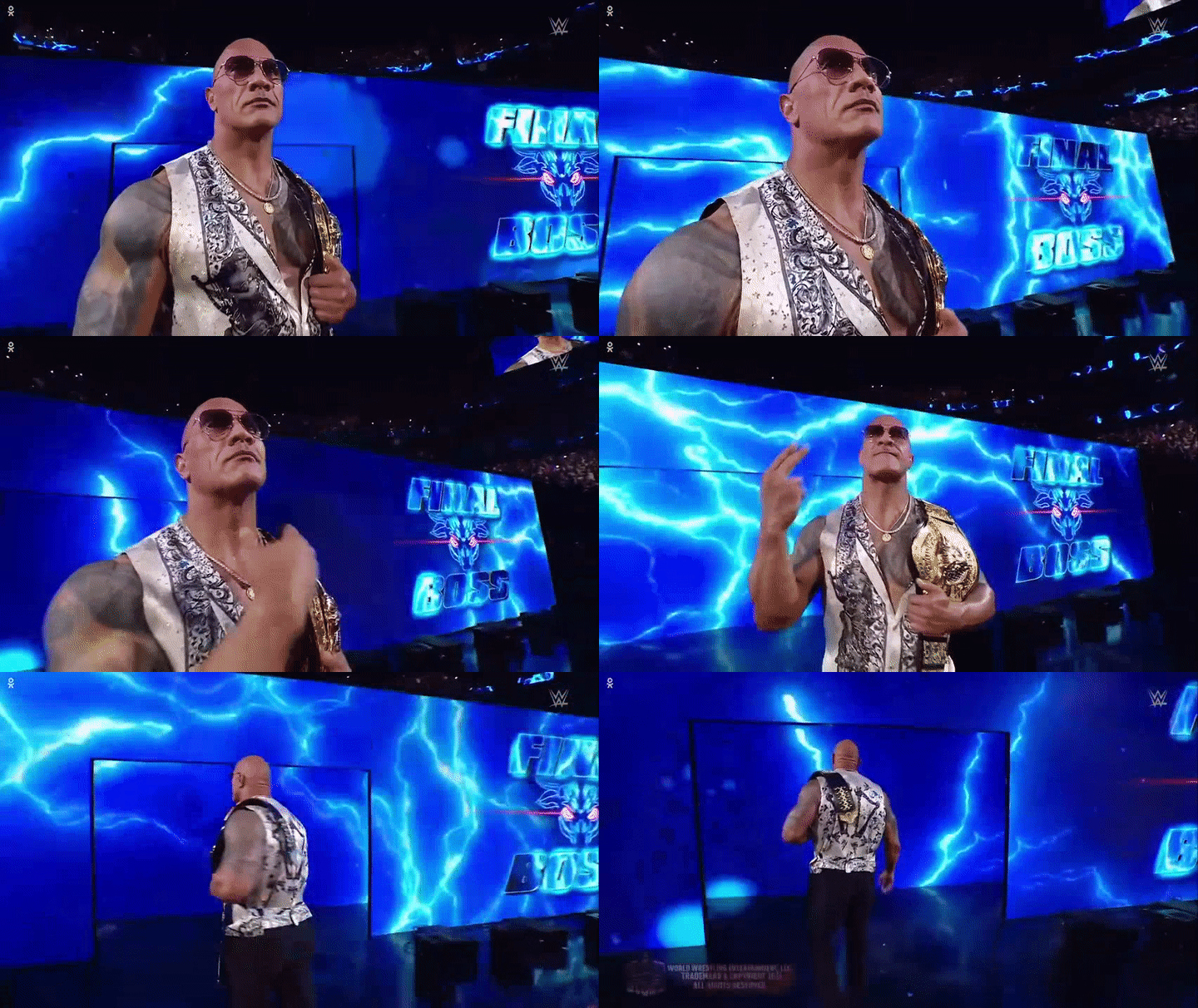
Yet he still appears in WWE today, even serving on the company’s Board of Directors—a role that inspired a new character: The Final Boss. He wrestled in the WrestleMania main event in 2024, now such a massive Hollywood star that he dictates his own schedule. As a third-generation wrestler, some say the pull is in his blood. Others echo Cena’s old criticism: that he always says he’s here to stay, only to leave again—or that he comes back for the money and to support a company he’s now financially invested in. For what it’s worth, Cena later apologized—out of character. Once Hollywood came calling, he realized how hard it is to juggle both worlds, even if returning to hear the crowd roar is still thrilling. Maybe it’s okay to never truly walk away.
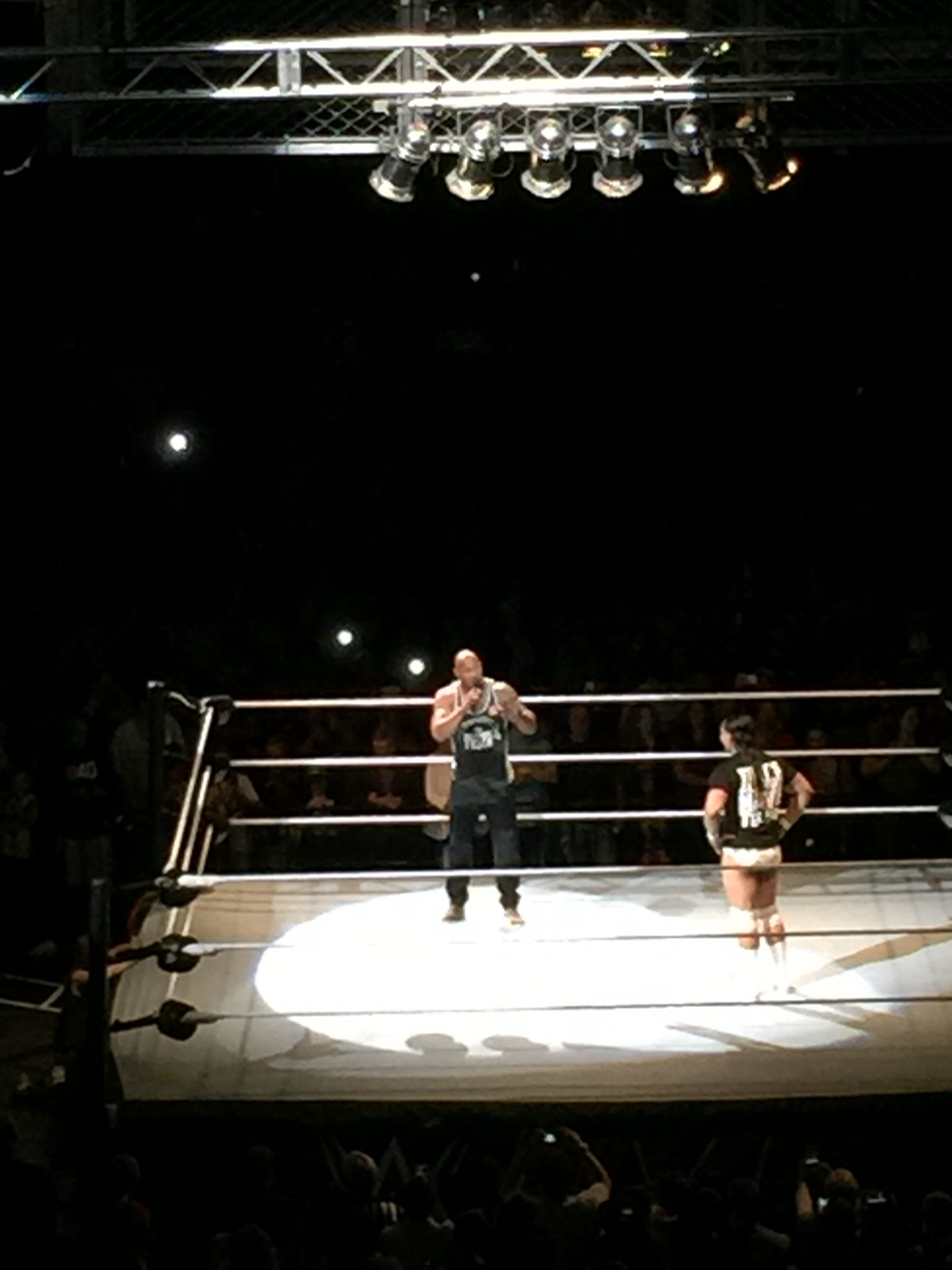
I know for a fact that sometimes Johnson comes back just for the joy of it. In 2015, my wife bought us tickets to a WWE house show at TD Garden in Boston. A house show has no cameras—just wrestlers performing for the live crowd. The Rock was filming Central Intelligence in Boston, and my wife, who follows him on Instagram, was convinced he’d show up. I, thinking I knew everything about wrestling, gently told her there was virtually no chance. He was busy filming. He doesn’t wrestle anymore. And certainly not without cameras.
She held out hope.
Mid-show, comedy wrestler Bo Dallas was in the ring, preaching his “Bo-Lieve” rhetoric, when suddenly the arena heard: “If ya smelllllll…” Out came Dwayne “The Rock” Johnson. After filming all day, he stopped by just to hear the crowd chant his name. He filmed the fans on his phone, hit Bo Dallas with the Rock Bottom and People’s Elbow, and left to a thunderous ovation.
My wife still reminds me she was right—that he showed up just for us.
I think she’s half right.
There were no cameras. No storyline. No real money at stake. He had already filmed all day and didn’t need to be there at all. But he walked through that curtain anyway, just to hear the crowd
Hollywood is easier than taking bumps every night. You’re unlikely to tear an abdominal muscle playing the Tooth Fairy. But there’s no substitute for standing in front of thousands of people who want you there right now.
That’s why he keeps coming back. Not for the money. Not for leverage. Not because he can’t let go.
Because once you’ve heard that roar, you never really stop chasing it.
He’s reached superstardom in both worlds, but there’s only one place where the reaction is immediate, unfiltered, and alive. And whenever he chooses to step back into it, the fans will scream.
They always do.
They always will.
Because he’s The Rock. And we smell what he’s cooking.
Thanks for reading. Drop me a comment if you have a favorite Rock moment oir quote. And be sure to like and subscribe if you haven’t already. We can’t all afford $500 shirts like The Rock can.