

Years ago, before Substack, mattdursin.com was a wordpress blog with almost no readership. I basically used it to complain about movies a lot (Shocking, right?), but occasionally, I had something to say. Here’s a slightly re-worked post on the movie The End of the Tour, based on David Lipsky's book, Although Of Course, You End Up Becoming Yourself: My Road Trip with David Foster Wallace, which is a pretty cool title, but I understand why a movie studio wouldn't think it very marketable.
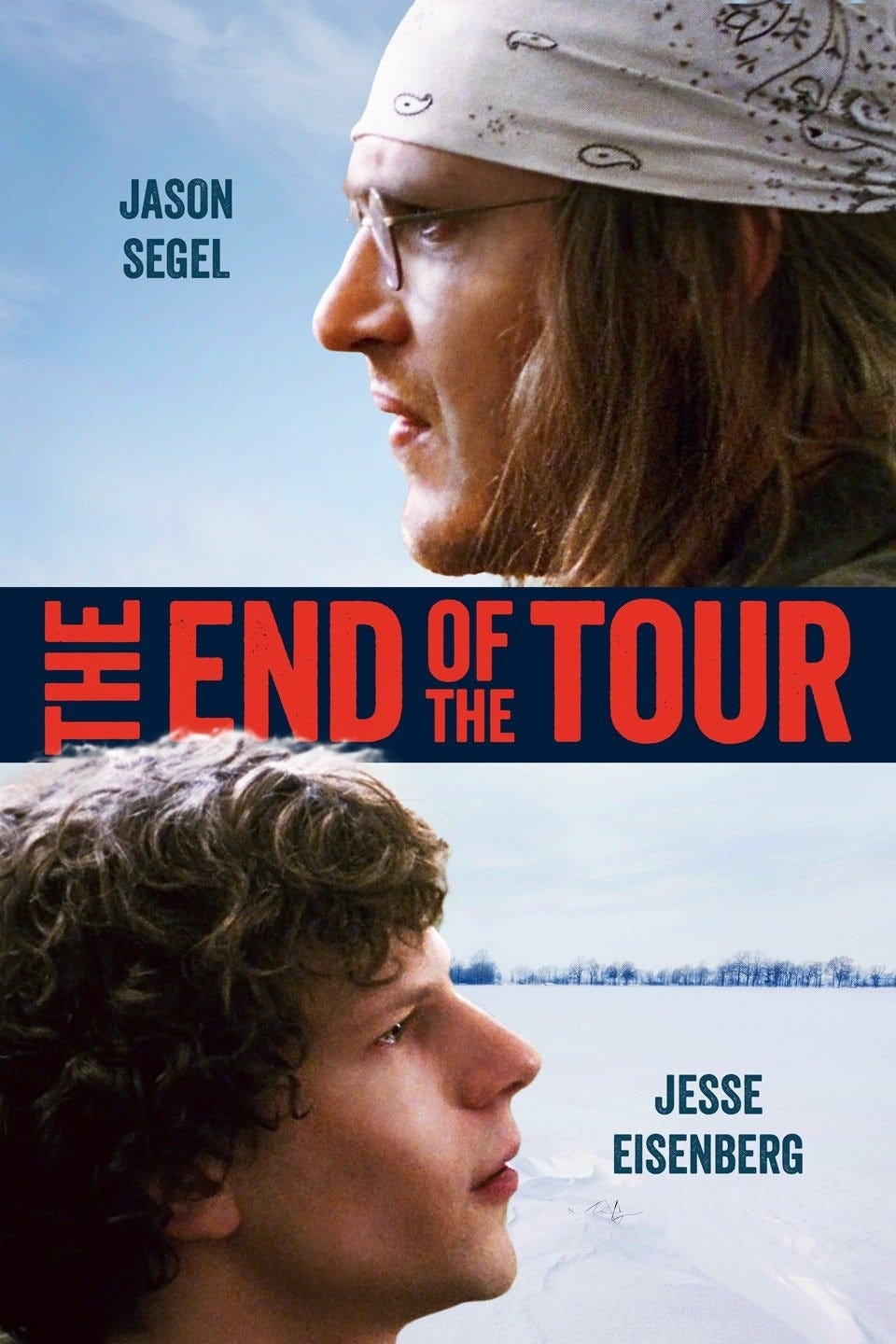
I never read the book, but the movie is a pretty interesting take on Wallace (Jason Seagal) and how he dealt with fame and success after the release of his book Infinite Jest. Since he committed suicide, it seems not so well.
The basic premise is that Lipsky (Jesse Eisenberg), a writer for Rolling Stone, hears that this Infinite Jest book is basically Shakespeare, and is rather annoyed at the praise, mostly because he just released a book to mild apathy. Lipsky then reads the book and discovers that it is that damn good, and asks his boss if he can interview Wallace for Rolling Stone, and follows him for a few days as Wallace is wrapping up his book tour.

Lipsky has a sort of puppy-love for Wallace even before meeting him, basically because he wants that level of success and respect. He quickly realizes that even David Foster Wallace doesn’t actually want to be David Foster Wallace. He is very nervous, slightly ornery, and very self-conscious about how he will come across in Lipsky’s article, mostly because he is afraid of sounding like a self-righteous douche. He is, in fact, anything but, as he generally is portrayed as a kind of lonely guy who lives in the middle of Nowhere, Illinois with his dogs. He enjoys writing, but isn’t really all that concerned if anyone likes his books. Obviously, Lipsky is the complete opposite, and can’t wrap his head around why this beatnik doesn’t care about anything.
There’s a funny scene where Lipsky asks Wallace why he wears a bandana all the time. Wallace’s answer is that he used to sweat a lot, and it kept the sweat out of his eyes, and it eventually just became a type of security blanket.

It’s a perfectly reasonable (if not very sexy) response, but Wallace is nervous that he will come off as being a little high-and-mighty, like some super-genius who is too good to comb, or even wash, his hair. Again, that is not even close to being true, but Wallace is so worried about being perceived as pretentious that he is completely neurotic about it. He is not too worried about his writing being accepted by the public, but he definitely doesn’t want the public to think he’s a prick. I kept wondering if he would just be more relaxed if he just allowed people to think he was pretentious.
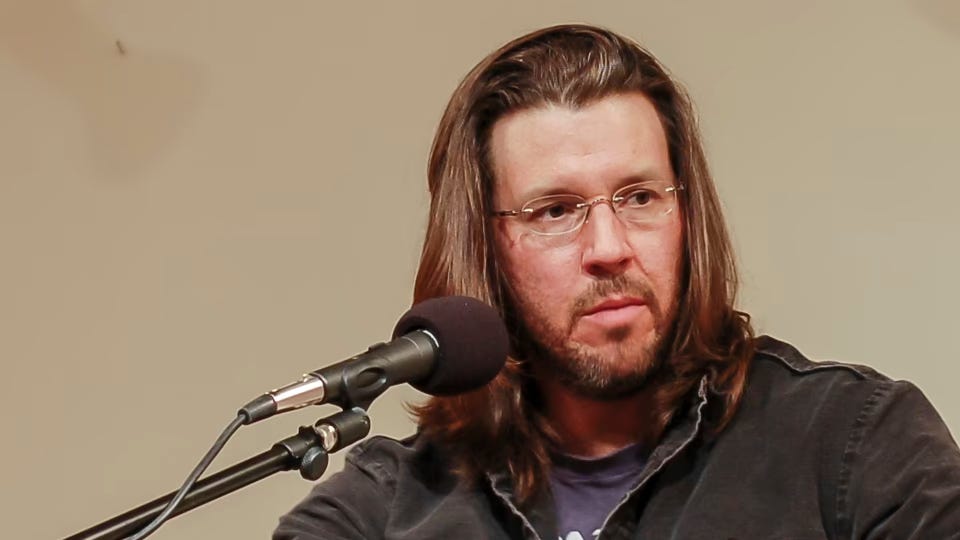
Lipsky, after being pressured by his boss, asks Wallace about the time he was institutionalized years earlier, because the common belief was that it was because of a heroin addiction. Wallace is incredibly insulted by this, citing that the only addiction he’s ever had was television (which is depicted very hilariously in the movie. He actually got rid of his TV, but will watch it anytime he is near one.) He tells Lipsky that he was just incredibly unhappy, so unhappy that people assumed he turned to heroin to make himself feel better. Wallace admits that it wasn’t drugs or a chemical imbalance that caused him to be institutionalized, but the realization that he had “lived an incredibly American life,” where he thought if he worked hard and was successful, everything would be ok, and that just ain’t true.
In all honesty, the movie does gloss over Wallace’s many foibles to tell the story they wanted to tell. Things like sleeping with his students, excessive drinking - which is mentioned but not really focused on - and even stalking women that he was attracted to. Definitely the actions of a lonely man, but I guess being a TV addict just made him more relatable.
Wallace compares his depression to a person jumping out the window of a burning building because the perception that burning to your death is worse than falling to it. The real reason he was so unhappy, at least the way I understood it, was because he had broken up with his girlfriend. It’s never made explicit, but Wallace gets very angry at Lipsky for hitting on his ex right in front of him, so I made the leap that he just wasn’t over her. Truly, that’s probably the one of the best reasons to be unhappy that’s ever been. Loneliness is certainly a more plausible reason for depression than, “Fame was too much for me, man.”
Wallace’s theory on loneliness, however, was that technology was going to keep getting better and better until it was going to make being alone “more pleasurable.” The crazy thing is that the movie was set in 1996, and I don’t know if Wallace ever said that in real life, but the movie came out in 2015, when it was already becoming more pleasurable to be alone, and Tiktok wasn’t even a thing yet. Wallace jokingly tells Lipsky that he is going to have to leave the planet to get away from all of the technology, which is, of course, exactly what he did.
I think the reason this movie spoke to me, though, was because I could see both sides of the coin. As a schlub who wrote a comic book that I wish sold better and hosts a podcast that I wish more people listened to, I could identify with Lipsky. You put your heart and soul into something you really love, you want people to like it as much as you do, and maybe make a little salad at the same time. However, as my life has gone on, and I've met some people who have succeeded in the fields that I tried to succeed in, I can also see a little bit of Wallace's point. He's a regular guy suffering from depression who happens to be blessed (or cursed?) with great intelligence, but all he really wants is to be regular, and have someone to talk about his day with when he gets home.
I admit that I don’t know much about the real David Foster Wallace (although he apparently taught at Emerson for a little while in 1991, so I guess I just missed him.), but if he’s anything like some of the professionals I have met, I do understand him. No one gets into comics or podcasting or starts a Substack because they want to become rich. They just have some creativity to spare and a need to express themselves, one way or another. I doubt that Wallace wrote a 1,000-plus page novel figuring that it would be The One. You could say he just got lucky, although considering how it ended up for him, you would probably be wrong.
As I said, however, I do understand Wallace on some level. I have enjoyed creating things, but I really do not enjoy marketing those things. He really didn't like his book tour. He didn't seem too happy to be featured in Rolling Stone. But he did seem to like having Lipsky around to talk to, and that's pretty much all anyone could ask for.
Of course, having said that, please like and subscribe to this Substack, and if you are willing and able, consider becoming a paid subscriber. I swear the money doesn’t go to heroin.
I've never read him, but I want to...