

When I was in college, I read the book The 36 Dramatic Situations for one of my screenwriting classes. I don’t remember all of the situations. In fact, I remember almost none of them. But it did help me realize that the plots of the movies I had seen, and would ever see, could be broken down into simple premises. But it was what the filmmakers did with those premises that made the movies stand out.
Drive and Baby Driver are basically the same dramatic situation; a skilled driver uses his expertise as the getaway driver for criminals. He meets and falls in love with a girl, and runs afoul of his mob bosses. Death and violence ensue.
That is about where their similarities end.
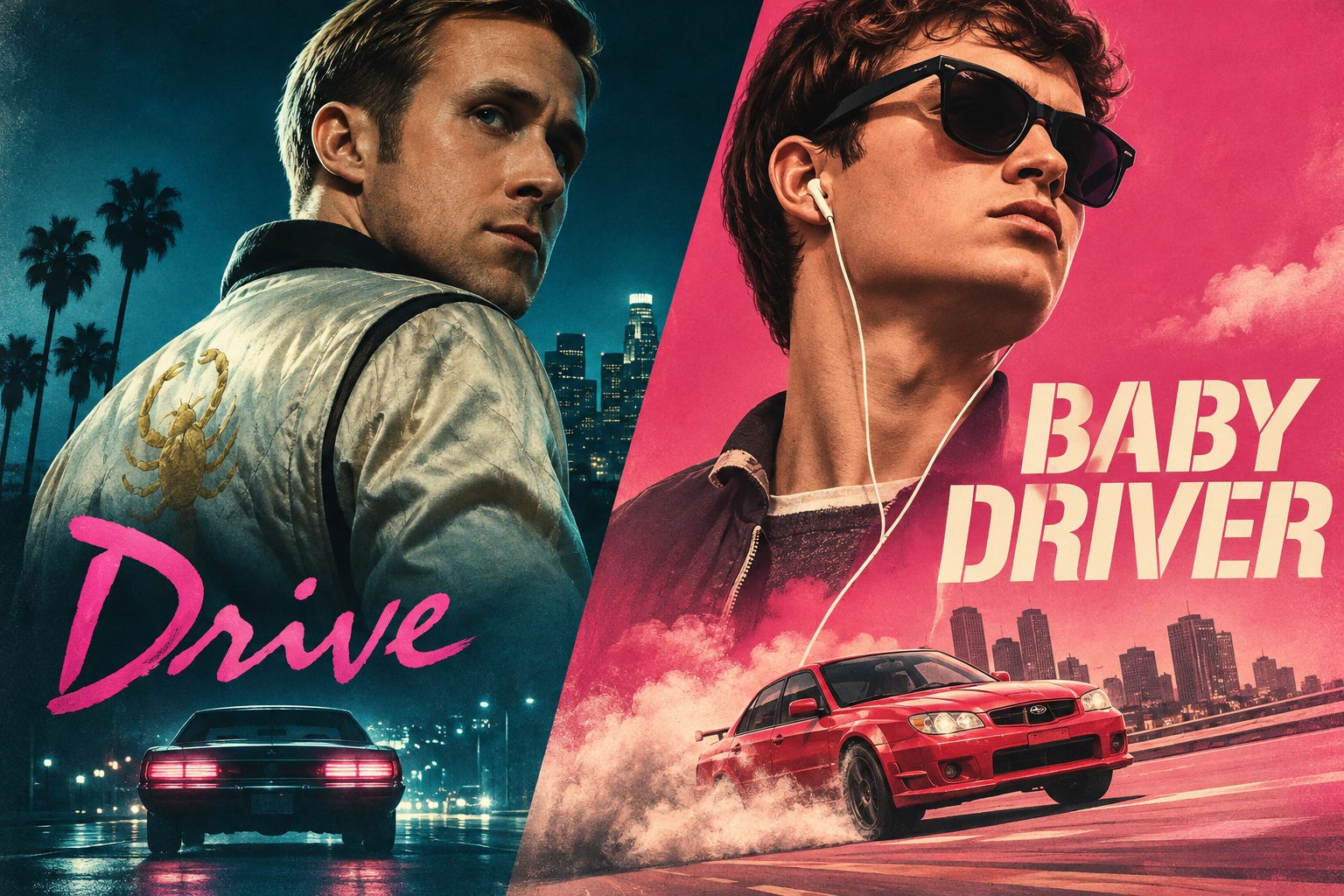
With Drive, director Nicolas Winding Refn chose a very minimalist approach to the script, even removing dialogue from the original draft, preferring to let his cinematography and soundtrack do the talking. We know almost nothing about Ryan Gosling’s character, not even his name. He is simply Driver. We know that he works as a mechanic and stunt driver, and moonlights as a getaway driver for criminals. Other than that, we are mostly left to construct our own narrative about who he might be.
In 2017’s Baby Driver, Edgar Wright gave us a main character with a backstory, motivation, a reason to like him, and great taste in music. We don’t fully know the circumstances that have gotten him into his situation, but we know he wants to get out of it, and Kevin Spacey, as his boss, won’t let him. Like Gosling, Ansel Elgort’s Baby doesn’t have a lot to say, but the script and music he listens to tell us everything we need to know.

I saw Baby Driver in a theater on opening weekend in 2017, and loved it. It is hands down one of the most fun movies I have seen in the last ten years. I watched Drive a few weeks ago in preparation for a podcast (which you should listen to here.)
I freely admit that may have impacted my opinion of the movie. I frequently pause movies to take notes while watching them for the podcast, and occasionally it can feel like homework. Let’s face it, pausing to switch over to a Google Doc and type, “Then Gosling stomped the guy’s head into mush,” may have taken me out of the movie a little bit.
But I honestly don’t think that’s the reason why I preferred Baby Driver over Drive. I think it had more to do with the fact that Baby Driver just spoke to me. Literally.
I came of age when Quentin Tarantino was making waves in Hollywood with dialogue-heavy crime dramas featuring larger-than-life characters, unexpected twists, and great soundtracks. Those were the kinds of movies I gravitated toward when I began studying film, and Edgar Wright’s movies have always scratched that same itch. Give me memorable characters, clever dialogue, and a story that takes a few unexpected turns, and I’m happy.
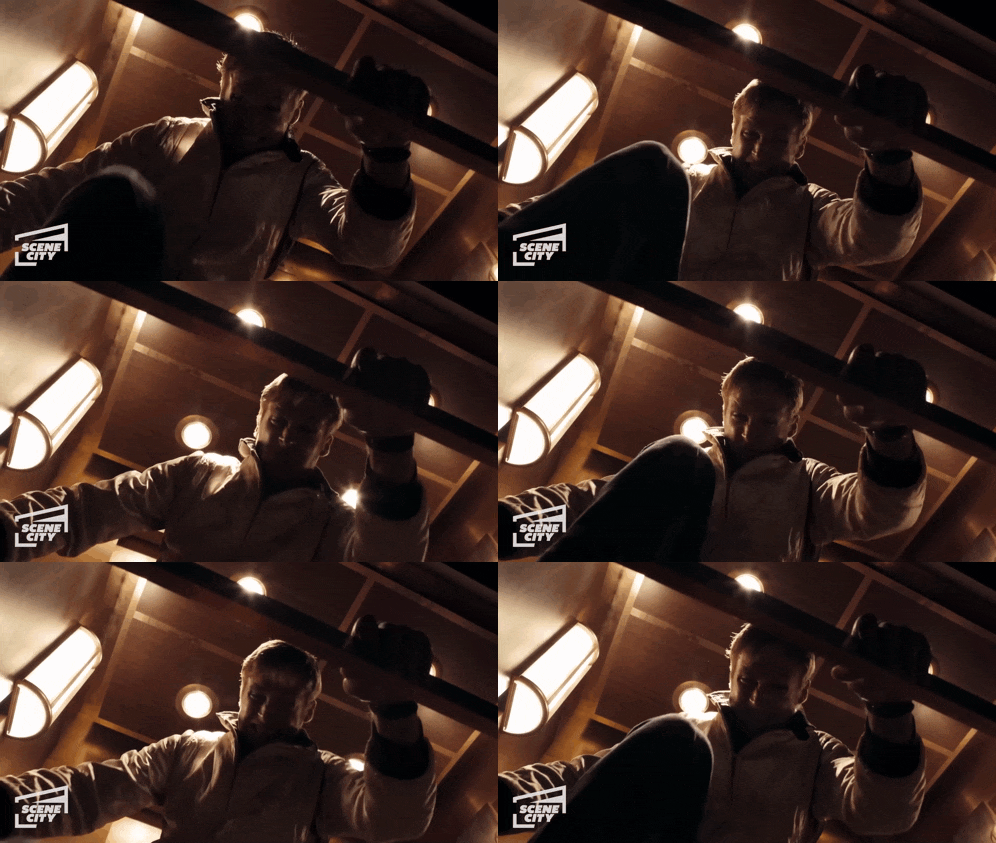
With Drive, Refn went another way. He chose to strip away all the bombast and show the audience something different. There were long shots of the streets of L.A. Whole scenes of Gosling staring into the distance, leaving the audience to interpret his motivations. Also, for a movie called Drive, there wasn’t even a lot of driving.
All of those college classes I took stressed that a writer should “show, don’t tell,” and here I was being shown everything and I still thought something was missing. The cinematography was beautiful, but I wanted a little more.
When we were discussing Drive for the podcast, I started to wonder if I had simply lost my taste for quiet, artsy films. Or was I just getting older and less patient with movies that seemed more interested in being cool than telling a story?
Eventually, I realized there was one simple moment in Baby Driver that illustrated why I preferred it over Drive. It’s almost a throwaway line, but it made all the difference to me.
In Drive, we are given all the basic criminal axioms: the bosses want their money, and they kill anyone who gets in their way. In the end, Gosling’s Driver meets with Albert Brooks’ mob boss, Bernie, to return the money. Bernie promises he won’t go after Driver’s girl, but warns him that he’ll spend the rest of his life looking over his shoulder, because bad guys would be coming for him, because that’s what bad guys do. The two men then stab each other, Bernie dies, and Gosling drives away, leaving the money and the girl behind, and possibly looking over his shoulder forever.
In Baby Driver, Baby and his girl, Debora, encounter Spacey’s Doc, who is initially enraged at Baby over the botched heist. But when he sees them together, he gives them a bag of money and wishes them well. Like Bernie, he also warns them that they’ll be looking over their shoulders for the rest of their lives for the “clean and dirty cops” who will be coming for them.
And then Doc reveals the reason for his change of heart. One simple line:
“I was in love once.”
Doc is almost immediately killed while trying to cover Baby and Debora’s escape by the real bad guy in the movie, Jon Hamm’s Buddy, who blames Baby for the death of his wife during the heist.
But that one line changed the whole dynamic of the movie for me. The mob boss who had been holding Baby hostage, and who we assumed would want to kill him to take the heat off himself, ends up giving his life to help Baby and Debora escape.
Because he was in love once.
It was the small thing I was looking for in Drive that I didn’t get. A small twist that doesn’t fundamentally change the plot, but gives the audience an unexpected glimpse into a character. There was a somewhat similar moment in Drive when Bernie kills Bryan Cranston’s Shannon by slicing his wrist open, then calmly tells him, “Don’t worry. That’s it. There’s no pain. It’s over.”
It’s a great moment, but Bernie is still Bernie. It didn’t surprise me the way Doc’s change of heart did. And sometimes, that’s all it takes to make one movie stick with me more than another.
These are two excellently made, extremely popular movies about getaway drivers. They both have their qualities, and both deserve their accolades. But if you asked me which one I wanted to watch tonight, I would pick Baby Driver.
Both movies took me for a ride. Only one took me somewhere I really wanted to go.