

The other day was the 40th anniversary of the release of Ferris Bueller’s Day Off, and as fate would have it, I was in Chicago. I saw the Sears/Willis Tower, which Ferris said was the world’s tallest building in the movie, but is now the 26th tallest 40 years later. Time, eh?
One of the highlights of the trip was visiting the Art Institute of Chicago, the very museum where Ferris, Sloane and Cameron go to look at “priceless works of art.” I’m sure Ferris would be delighted to know that the museum even offers a Ferris Bueller Tour.

Probably like a lot of people my age, that was really all I could think about while walking through the halls: “These were the Chagall windows that Ferris and Sloane kissed in front of” or “This was the statue that they all posed in front of, folding their arms.”
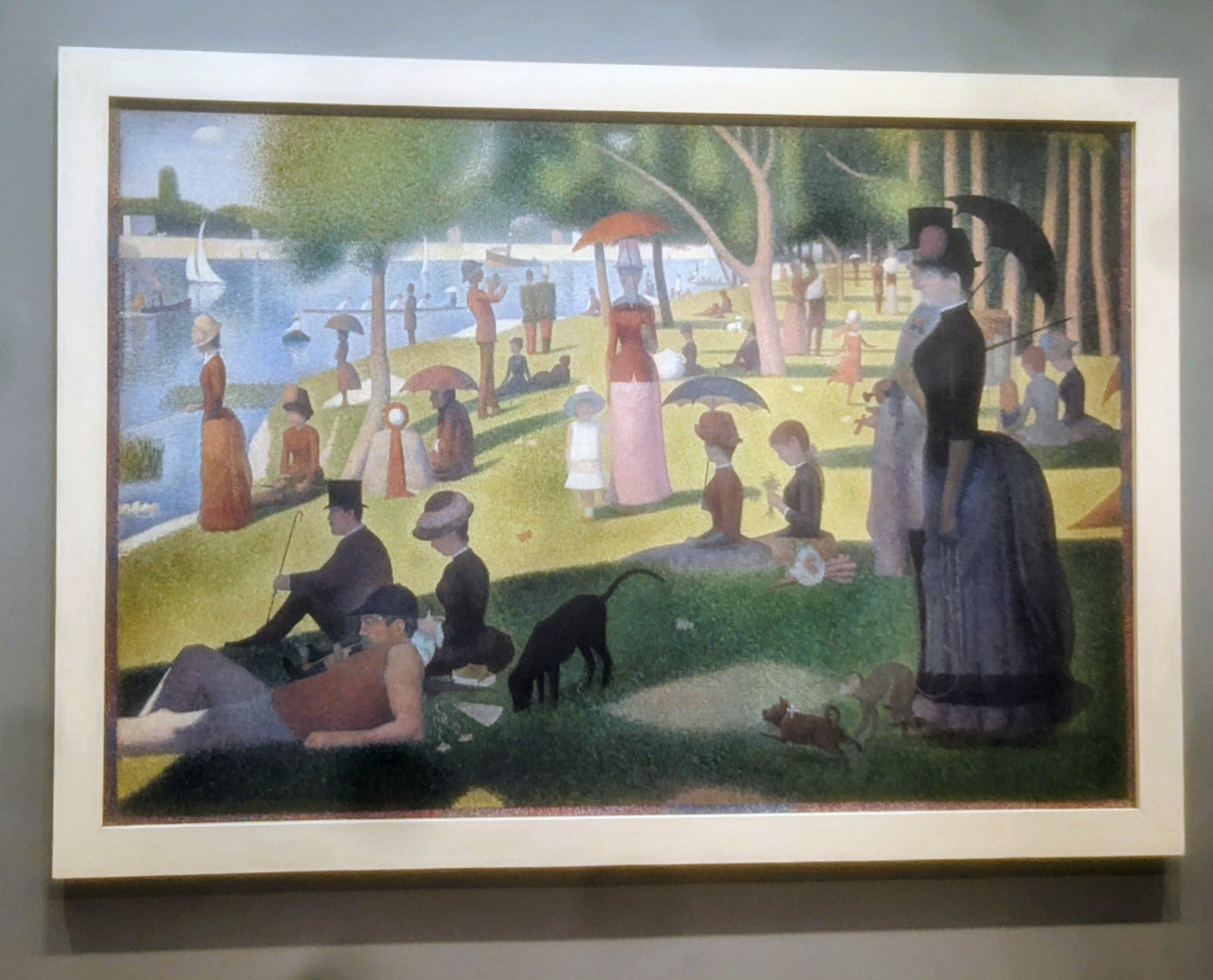
And standing in front of Georges Seurat's A Sunday Afternoon on the Island of La Grande Jatte, I couldn't help but think about Cameron Frye staring into the painting forty years earlier.
How is it that this teen comedy about skipping school has become part of our culture decades later? And why is it permanently etched in my brain?
Well, I have a theory on that.
I was too young to see it in theaters, but once it hit video stores, Ferris Bueller’s Day Off became hugely popular with kids my age. It was one of those movies I rented over and over and eventually had it memorized.
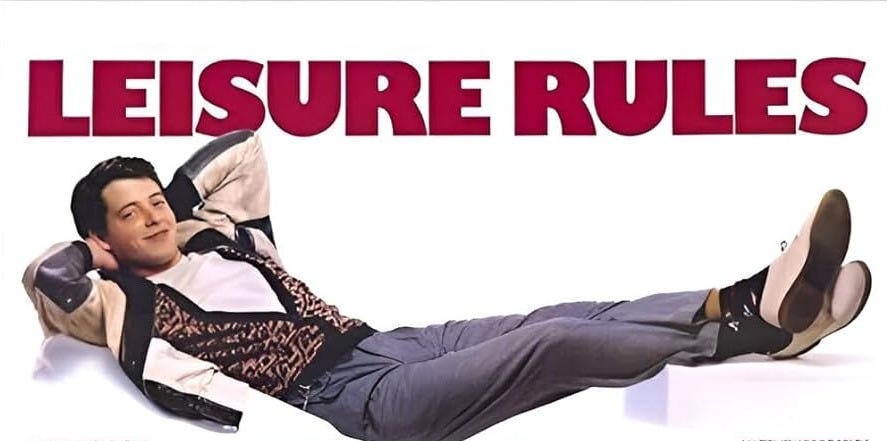
Ferris was confident, funny, had a beautiful girlfriend, and somehow managed to skip school nine times without consequences.
At eleven years old, skipping school felt like a mortal sin to me—right alongside staying out after dark or saying “hell” in front of an adult.
And Ferris didn’t just skip school. He did everything you weren’t supposed to do. He embarrassed his principal, lied to his parents, stole his friend’s father’s Ferrari, impersonated the Sausage King of Chicago to get into a fancy restaurant, and somehow ended up catching a foul ball at Wrigley Field.
After years of “One to Grow On” messages during Saturday morning cartoons and Knowing Is Half the Battle PSAs after G.I. Joe, here was a guy who openly rejected all of it.
How could I not admire him?
Over the years, I’ve heard-tell about deleted scenes that would have made Ferris far less likable. Apparently there were harsher rants to the camera and moments that made him seem more selfish or entitled—like calling his father to ask where his savings bonds were so he could finance the day off.
And honestly, the movie already gives you hints of that. Ferris lives in a wealthy Chicago suburb, has loving parents, a nice house, and a devoted girlfriend, yet still can’t bring himself to simply go to school. A lot of people probably saw him as spoiled.
But I didn’t think about any of that when I was eleven. I just thought he was what the school secretary called him: “A righteous dude.”
And I wasn’t alone. I think a lot of us wanted to get away with the things Ferris did—not because we were criminals, but because we were tired of being told exactly how we were supposed to behave all the time. And I honestly think Ferris Bueller inspired some of my own minor acts of rebellion once I got older, like taking a couple extra free passes from the movie theater I worked at, or putting aside a new movie at the video store. Not big stuff. Just enough to make life a little more interesting. It moves pretty fast, after all.
But the older I get, the more I realize I never actually wanted to be Ferris. I was much more like Cameron.
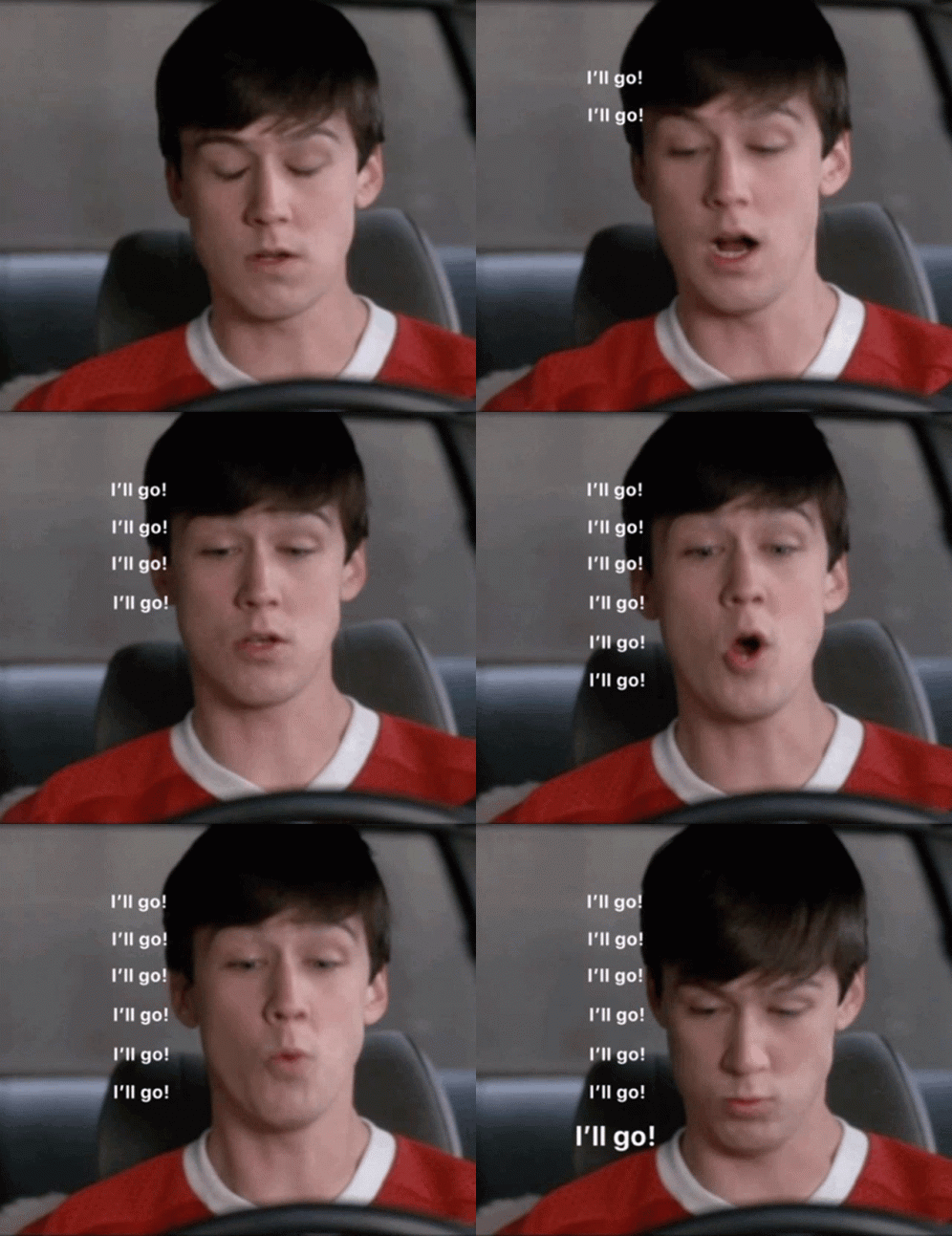
Most of us probably were. Slightly afraid of authority. More anxious than we wanted to admit. Careful. Nervous. The kind of person who would absolutely panic if a friend borrowed my father’s Ferrari.
And there’s one line in the movie that has always stuck with me.
While talking to the audience about the Ferrari, Ferris casually says:
“I caught Cameron digging the ride once or twice. It’s good for him. It teaches him to deal with his fear.”
Then he immediately moves on to talking about how “choice” the car is. But that line always resonated with me. Because Cameron doesn’t just admire the Ferrari. He has obviously taken it out himself. He says his dad knows the mileage, but Cameron knows it, too, because he has driven the car without permission and worried about putting extra miles on it. He’s touching something he’s not supposed to touch, and doing something he’s not supposed to do.
That’s the whole point.
The Ferrari is beautiful and untouchable—like everything else in Cameron’s house. Ferris even describes the place as a museum where you’re not allowed to touch anything.
And Cameron does. And of course it goes badly. At the end of the movie, Cameron destroys the Ferrari. Even when Ferris offers to take the blame for it, Cameron refuses. He even tells Ferris that he “let” him take the car out that morning. Ferris thinks that he manipulated the whole outing, but Cameron points out that he could have stopped him, that he had a say in everything. It is the only time in the movie where it is pointed out that Ferris could be stopped at all.
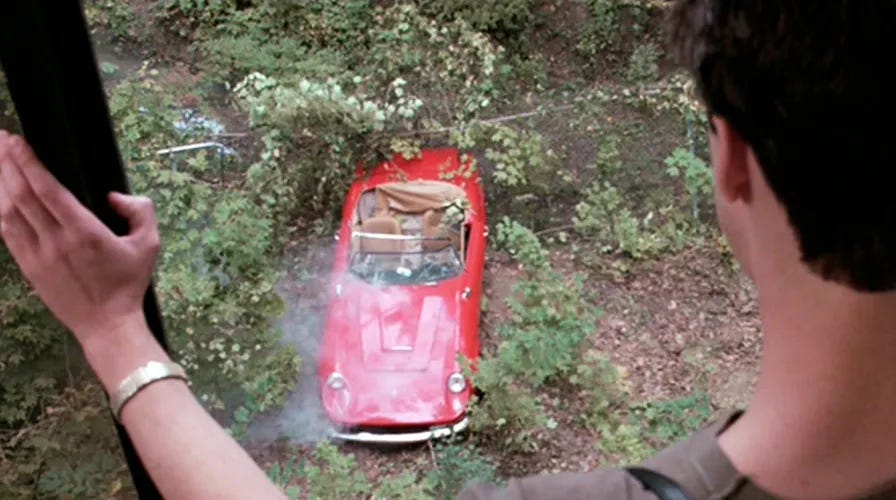
This New Cameron finally decides to confront his father, not just about the car, but about how he is treated in general, completing the real character arc of the film. Because Ferris Bueller’s Day Off isn’t actually about Ferris. Ferris doesn’t change. Everyone around him does. His Principal. His sister. Cameron.
Ferris is just the disruption that forces them to move.
And maybe that’s why the movie stuck with me. Not because I wanted to become some charming rule-breaker who could outsmart the world.
I just wanted to dig the ride once or twice.
Thanks for reading. And remember, “a person should not believe in an -ism, he should believe in himself.” Also, don’t forget to like and subscribe.